Why World Models?
From Vision to JEPA, Reinforcement Learning and Agents.
1. Why World Models over the Classical Ones?
Most AI models solve a specific problem:
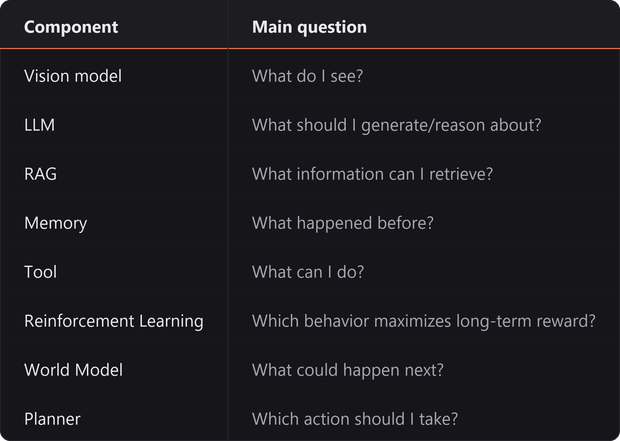
The key idea of a World Model is:
Current State + Action
          ↓
   Future State
Instead of only reacting to the current observation, the agent can model possible future states before acting.
2. From Perception to World Modeling
A vision model can detect objects:
Image
  ↓
Vision Encoder
  ↓
Objects / Features
For example:
Image → YOLO → car, person, road
This answers:
What is present?
A World Model adds temporal and dynamic information:
Observation(t)
      +
Action(t)
      ↓
World Model
      ↓
Predicted State(t+1)
The question becomes:
What happens if I perform this action?
3. Vision as the First Layer
World Models need a representation of the environment.
Several vision architectures provide useful building blocks.
CNN
CNNs extract hierarchical visual features:
Pixels
 ↓
Edges
 ↓
Textures
 ↓
Shapes
 ↓
Objects
ViT
Vision Transformer:
Image
 ↓
Patch Embedding
 ↓
Visual Tokens
 ↓
Transformer
 ↓
Visual Representation
YOLO
Object detection:
Image
 ↓
YOLO
 ↓
Bounding Boxes + Classes
DETR
Transformer-based object detection:
Image
 ↓
Backbone
 ↓
Transformer
 ↓
Object Queries
 ↓
Objects
SAM
Segmentation:
Image
 ↓
SAM
 ↓
Segmentation Masks
CLIP
Joint image-text representation:
Image → Image Embedding
              ↕
          Similarity
              ↕
Text  → Text Embedding
These models provide perception and representations that can feed a World Model.
4. Why Latent Space?
A World Model does not necessarily need to predict every pixel.
An image contains a large amount of information:
1920 × 1080 × 3 pixels
But for planning, the important information may be:
Objects
Positions
Motion
Relations
Context
Environment State
Therefore:
Observation
     ↓
Encoder
     ↓
Latent State
     ↓
World Model
The objective is to learn a compact representation that preserves information useful for prediction and decision-making.
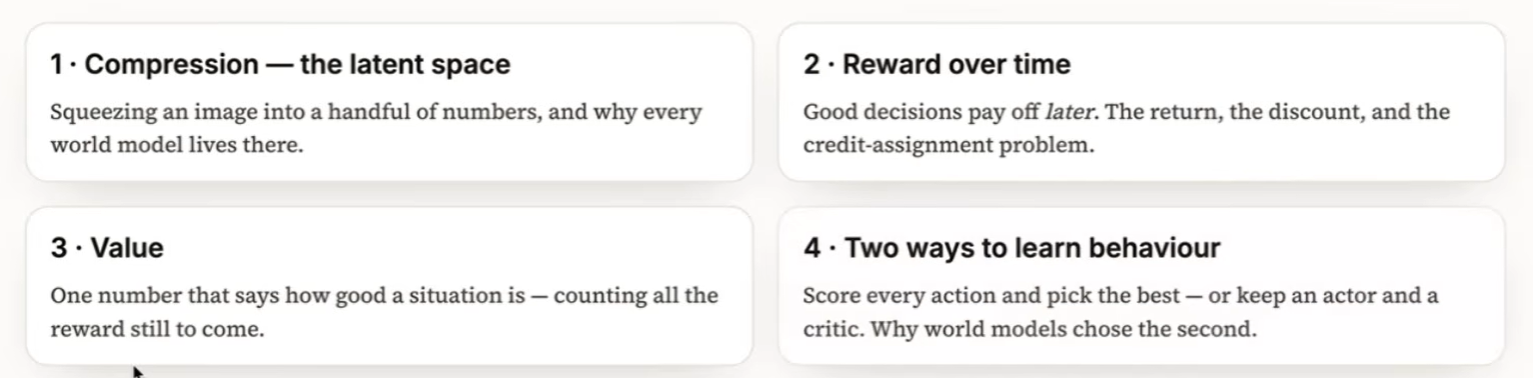
5. The Four Core Ideas
A useful way to understand World Models together with Reinforcement Learning is through four concepts:
- Compression / latent representation
- Reward over time
- Value
- Behavior learning
5.1 Compression — Latent Space
Instead of modeling raw observations directly:
Pixels
 ↓
Encoder
 ↓
Latent Representation
The latent state should contain the information needed to predict relevant future states.
A simplified dynamics model is:
where:
- \(z_t\) = current latent state
- \(a_t\) = action
- \(z_{t+1}\) = predicted future latent state
5.2 Reward Over Time
In Reinforcement Learning, an action can have consequences several steps later.
The return is:
where:
- \(r_t\) = reward at time \(t\)
- \(\gamma\) = discount factor
Therefore, an action should not only be evaluated by its immediate reward.
Action
 ↓
Immediate reward
 ↓
Future states
 ↓
Future rewards
This is one reason temporal modeling is important.
5.3 Value
The value function estimates the expected future return from a state:
Simplified:
State
 ↓
Value
 ↓
Expected future quality
This is useful for comparing possible trajectories.
5.4 Learning Behavior
A common RL architecture separates the Actor and Critic:
              State
             /     \
            ↓       ↓
         Actor     Critic
           ↓         ↓
        Action      Value
- Actor: chooses an action.
- Critic: evaluates the state/action.
This is close to the broader cognitive architecture proposed by Yann LeCun, where a World Model sits alongside Perception, an Actor and a Critic:
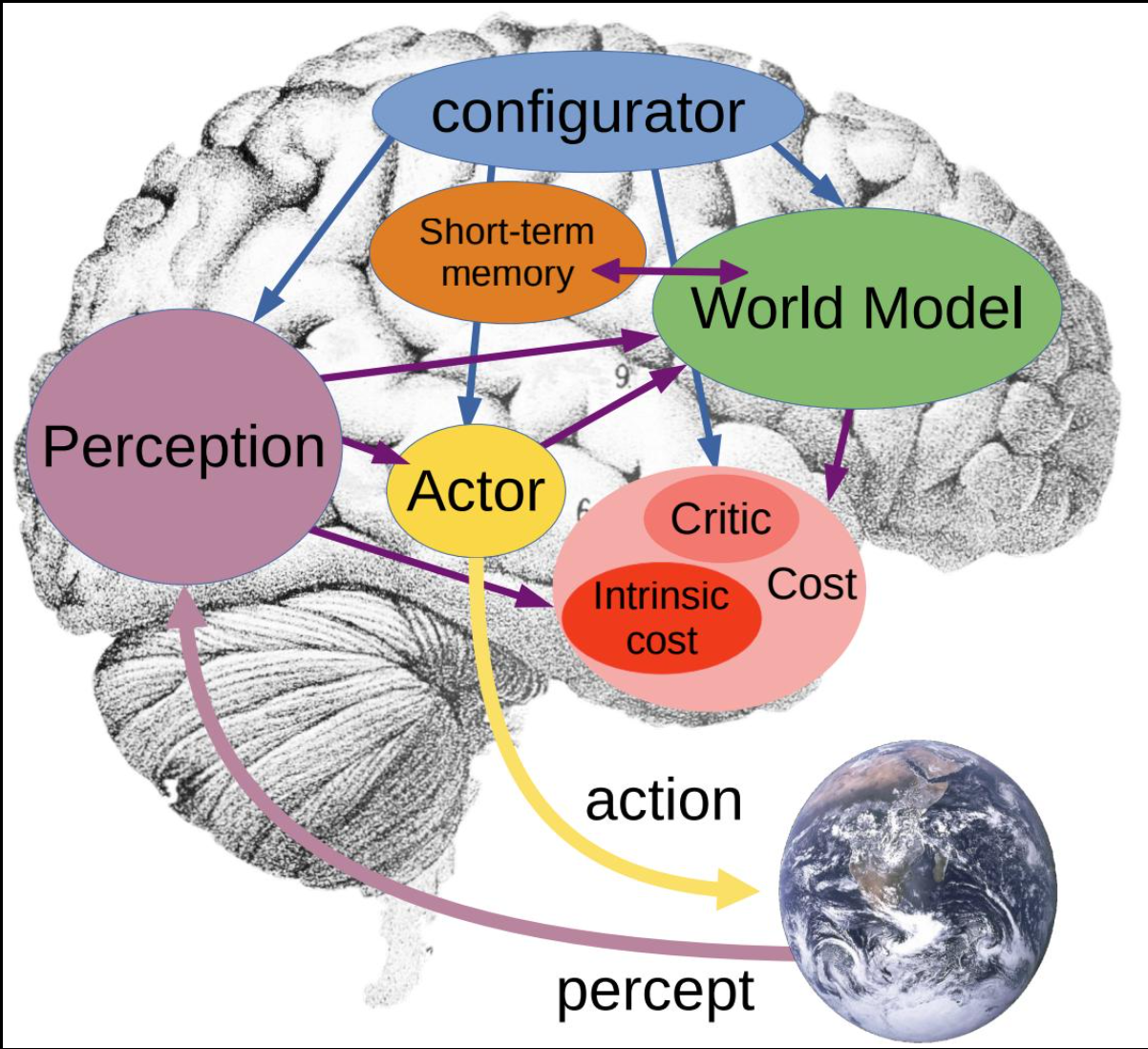
This can be combined with a World Model:
Current State
      ↓
World Model
      ↓
Possible Futures
      ↓
Critic / Value
      ↓
Planner / Actor
      ↓
Action
6. Model-Free vs Model-Based Reinforcement Learning
Model-Free RL
The agent learns a direct mapping:
State
 ↓
Policy
 ↓
Action
The agent mainly learns:
In this situation, which action works?
Model-Based RL
The agent also learns a model of the environment:
State + Action
       ↓
  World Model
       ↓
 Future State
       ↓
   Planning
       ↓
     Action
The agent can therefore evaluate actions using predicted outcomes.
7. World Models and Simulation
The main advantage of a learned world model is the possibility of simulation.
Suppose the agent has three possible actions:
Current State
     │
     ├── Action A → Future A
     │
     ├── Action B → Future B
     │
     └── Action C → Future C
The agent can evaluate the predicted futures before executing an action.
This creates:
Observe
   ↓
Represent
   ↓
Predict
   ↓
Simulate
   ↓
Evaluate
   ↓
Plan
   ↓
Act
8. World Models + Planning
The World Model and the Planner have different roles.
World Model
What could happen?
Planner
Which sequence of actions should I choose?
             Current State
                   ↓
             World Model
                   ↓
          Predicted Futures
            /      |      \
           A       B       C
           ↓       ↓       ↓
        Future   Future   Future
            \      |      /
                 Planner
                    ↓
                Best Action
9. World Models + Reinforcement Learning
The complete loop becomes:
Environment
     ↓
Observation
     ↓
World Model
     ↓
Predicted Future States
     ↓
Value / Reward
     ↓
Planning
     ↓
Action
     ↓
Environment
This is the basis of many model-based RL approaches.
10. World Models
One important early work is World Models by Ha and Schmidhuber (2018).
The idea was to learn a compressed spatial-temporal representation of an environment and use this learned model to train a controller in an imagined environment.
Conceptually:
Real Environment
      ↓
Collect Experience
      ↓
Learn World Model
      ↓
Dream / Simulate
      ↓
Train Controller
      ↓
Real Environment
Reference:
- Ha & Schmidhuber, World Models, 2018
- https://arxiv.org/abs/1803.10122
11. Dreamer
Dreamer is another important family of model-based RL methods.
The central idea is to learn an environment model and improve the policy using imagined trajectories.
Real Experience
      ↓
World Model
      ↓
Latent Dynamics
      ↓
Imagined Trajectories
      ↓
Actor-Critic
      ↓
Improved Policy
DreamerV3 extended this approach across a broad set of tasks.
Reference:
- Hafner et al., Mastering Diverse Domains through World Models, 2023
- https://arxiv.org/abs/2301.04104
12. MuZero
MuZero is important because it does not need to reconstruct the complete environment.
It learns the information needed for planning:
Observation
    ↓
Representation
    ↓
Dynamics
    ↓
Reward / Value
    ↓
Planning
MuZero combines learned representations and dynamics with search.
It was demonstrated on environments including Atari and board games such as Go, chess and shogi.
Reference:
- Schrittwieser et al., Mastering Atari, Go, Chess and Shogi by Planning with a Learned Model, Nature, 2020
- https://www.nature.com/articles/s41586-020-03051-4
13. JEPA
JEPA stands for:
Joint Embedding Predictive Architecture
The main idea is to predict representations rather than reconstruct every pixel.
Simplified:
Context
   ↓
Encoder
   ↓
Context Embedding
   ↓
Predictor
   ↓
Predicted Target Embedding

Target
   ↓
Target Encoder
   ↓
Target Embedding
The objective is to make the predicted representation close to the target representation.
This is different from pixel-level reconstruction.
14. I-JEPA
I-JEPA applies this principle to images.
Instead of predicting the exact pixels of a missing region, the model predicts the representation of that region.
Image
 ↓
Context Region
 ↓
Encoder
 ↓
Predictor
 ↓
Target Representation
The important idea is:
Learn useful semantic representations without requiring pixel-level reconstruction.
Reference:
- Assran et al., Self-Supervised Learning from Images with a Joint-Embedding Predictive Architecture, CVPR 2023
- https://arxiv.org/abs/2301.08243
15. V-JEPA
V-JEPA extends the JEPA idea to video.
A video contains both spatial and temporal information:
Frame(t-2)
Frame(t-1)
Frame(t)
Frame(t+1)
Frame(t+2)
Therefore:
Video
 ↓
Spatio-Temporal Representation
 ↓
Predict Missing / Future Representation
This is relevant to World Models because an environment is not static.
The model must represent:
What is here?
+
How does it change?
16. V-JEPA 2
V-JEPA 2 extends the predictive representation idea toward world modeling and physical reasoning.
A simplified view is:
Video
 ↓
Vision Encoder
 ↓
World Representation
 ↓
Predictor
 ↓
Future Representation
With action-conditioned learning:
Current State + Action
          ↓
       Predictor
          ↓
    Future State
This creates a connection between:
Self-Supervised Vision
        +
JEPA
        +
World Models
        +
Actions
        +
Planning
        +
Robotics
Reference:
- Meta AI, V-JEPA 2
- https://ai.meta.com/blog/v-jepa-2-world-model-benchmarks/
17. World Model vs LLM
A simplified distinction:
LLM
Tokens
 ↓
Transformer
 ↓
Next-token prediction
World Model
State + Action
      ↓
Future State
They can work together:
              Agent
                │
        ┌───────┴───────┐
        ↓               ↓
       LLM          World Model
        ↓               ↓
 Reasoning        Prediction
        │               │
        └───────┬───────┘
                ↓
             Planning
                ↓
              Action
A World Model is therefore not a replacement for an LLM.
It provides a model of an environment and its dynamics.
18. World Model vs RAG
RAG and World Models solve different problems.
RAG
Question
 ↓
Retriever
 ↓
Documents
 ↓
LLM
 ↓
Answer
Main question:
What information can I retrieve?
World Model
Current State
      +
Action
      ↓
Future State
Main question:
What could happen?
Therefore:
RAG       → Knowledge
Memory    → History
LLM       → Reasoning
World Model → Dynamics
Planner   → Decision
Tools     → Action
19. World Model + Agents
A simple agent loop is:
Observe
   ↓
Think
   ↓
Act
A more advanced agent can use:
Observe
   ↓
Understand
   ↓
World Model
   ↓
Predict
   ↓
Plan
   ↓
Validate
   ↓
Act
   ↓
Observe Again
This is particularly relevant to agentic systems.
20. Connection with Context Engineering
Context Engineering manages what the agent knows at a given moment:
System Instructions
+
User Request
+
Memory
+
RAG
+
Tool Results
+
Current State
A World Model adds another capability:
Current Context
      ↓
World State
      ↓
Dynamics
      ↓
Future Prediction
So:
Context Engineering
→ What information is available?

World Model
→ How can the environment evolve?
21. Gymnasium
To experiment with these ideas, Gymnasium is particularly useful.
It provides standardized Reinforcement Learning environments and an API for agent-environment interaction.
The basic loop is:
Observation
    ↓
Agent
    ↓
Action
    ↓
Environment
    ↓
Reward + New Observation
Basic example:
import gymnasium as gym

env = gym.make("CartPole-v1")

observation, info = env.reset()

for _ in range(1000):
    action = env.action_space.sample()

    observation, reward, terminated, truncated, info = env.step(action)

    if terminated or truncated:
        observation, info = env.reset()

env.close()
Reference:
- https://gymnasium.farama.org/
22. Why Gymnasium is useful for World Model projects
Gymnasium provides controlled environments where we can collect transitions:
(s_t, a_t, r_t, s_t+1)
This is exactly the type of data required to learn environment dynamics.
For example:
State + Action
      ↓
World Model
      ↓
Predicted Next State
Then compare:
Predicted State
       vs
Real State
This gives a measurable prediction error.
23. A Practical World Model Project Roadmap
Project 1 — Model-Free RL
Start with:
Gymnasium
   ↓
Observation
   ↓
Policy
   ↓
Action
Examples:
- CartPole
- MountainCar
- LunarLander
Project 2 — Learn Environment Dynamics
Collect:
(s_t, a_t, r_t, s_t+1)
Train:
f(s_t, a_t) → s_t+1
Then measure:
Prediction Error
Project 3 — Model-Based RL
Use the learned model:
State
 ↓
World Model
 ↓
Simulate actions
 ↓
Evaluate futures
 ↓
Choose action
Project 4 — Latent World Model
Instead of predicting raw states:
Observation
 ↓
Encoder
 ↓
Latent State
 ↓
Dynamics Model
 ↓
Future Latent State
This is closer to modern latent world model approaches.
Project 5 — Vision World Model
Use visual observations:
Image / Video
      ↓
Vision Encoder
      ↓
Latent State
      ↓
World Model
      ↓
Future Latent State
Possible encoders:
ViT
CLIP
CNN
Video Transformer
JEPA-style encoder
Project 6 — Agent + World Model
Final architecture:
Environment
     ↓
Perception
     ↓
World Model
     ↓
Simulation
     ↓
Value
     ↓
Planner
     ↓
Agent
     ↓
Tools / Actions
     ↓
Environment
24. A Complete Architecture
                         ENVIRONMENT
                              │
                              ▼
                         PERCEPTION
                              │
                  ┌───────────┴───────────┐
                  │                       │
                 Vision                  Text
                  │                       │
                  └───────────┬───────────┘
                              ▼
                        WORLD STATE
                              │
                              ▼
                        WORLD MODEL
                              │
                    ┌─────────┴─────────┐
                    ↓                   ↓
                Prediction          Simulation
                    │                   │
                    └─────────┬─────────┘
                              ↓
                           VALUE
                              ↓
                           PLANNER
                              ↓
                            AGENT
                              │
                       ┌──────┴──────┐
                       ↓             ↓
                     LLM           Tools
                       │             │
                       └──────┬──────┘
                              ↓
                          VALIDATION
                              ↓
                            ACTION
                              ↓
                         ENVIRONMENT
                              │
                              └────→ New Observation
25. Main Challenges
World Models are not perfect.
Prediction Error
Predicted Future
       ≠
Real Future
Error Accumulation
Prediction t1
     ↓
Prediction t2
     ↓
Prediction t3
     ↓
Increasing uncertainty
Distribution Shift
A model trained in one environment may fail in another.
Representation
The model must learn what information is actually useful for prediction and planning.
Computation
Long-horizon simulation can be expensive.
26. The Core Idea
The progression can be summarized as:
CNN
 ↓
What do I see?

Transformer
 ↓
How are the elements related?

Vision Models
 ↓
What is in the environment?

LLM
 ↓
How can I reason about information?

RAG
 ↓
What information can I retrieve?

Agent
 ↓
What can I do?

Reinforcement Learning
 ↓
Which behavior maximizes future reward?

World Model
 ↓
What could happen if I act?
And the complete loop becomes:
OBSERVE
   ↓
REPRESENT
   ↓
PREDICT
   ↓
SIMULATE
   ↓
EVALUATE
   ↓
PLAN
   ↓
ACT
   ↓
OBSERVE AGAIN
27. Final Takeaway
A World Model is not simply another neural network architecture.
It is a way to model the dynamics of an environment so that an agent can:
- represent its current state;
- predict possible future states;
- evaluate consequences;
- simulate actions;
- plan;
- act;
- learn from feedback.
The main connection between the topics is:
Computer Vision
      ↓
Representation Learning
      ↓
JEPA
      ↓
World Model
      ↓
Prediction
      ↓
Reinforcement Learning
      ↓
Value
      ↓
Planning
      ↓
Agents
      ↓
Action
The essential transition is:
Perception
    ↓
Prediction
    ↓
Simulation
    ↓
Planning
    ↓
Action
That is the main reason to study World Models.
References
-
Ha, D. & Schmidhuber, J. — World Models (2018)
https://arxiv.org/abs/1803.10122 -
Assran et al. — Self-Supervised Learning from Images with a Joint-Embedding Predictive Architecture (I-JEPA, CVPR 2023)
https://arxiv.org/abs/2301.08243 -
Schrittwieser et al. — Mastering Atari, Go, Chess and Shogi by Planning with a Learned Model (MuZero, Nature 2020)
https://www.nature.com/articles/s41586-020-03051-4 -
Hafner et al. — Mastering Diverse Domains through World Models (DreamerV3, 2023)
https://arxiv.org/abs/2301.04104 -
Meta AI — V-JEPA 2
https://ai.meta.com/blog/v-jepa-2-world-model-benchmarks/ -
Gymnasium — Reinforcement Learning environments
https://gymnasium.farama.org/